Why doesn’t my home brew match the coffee shop?
This guide helps you diagnose why the same coffee can taste different at home and how to close the quality gap with practical, controlled brew tests. Jump to FAQ.
Why the same beans can taste different at home
Even with the same coffee beans, results can differ because cafes often use tighter grinder calibration, stable water, and repeatable workflow timing.
Home brews improve fastest when you diagnose one likely gap first, then test a single focused change.
Demo examples
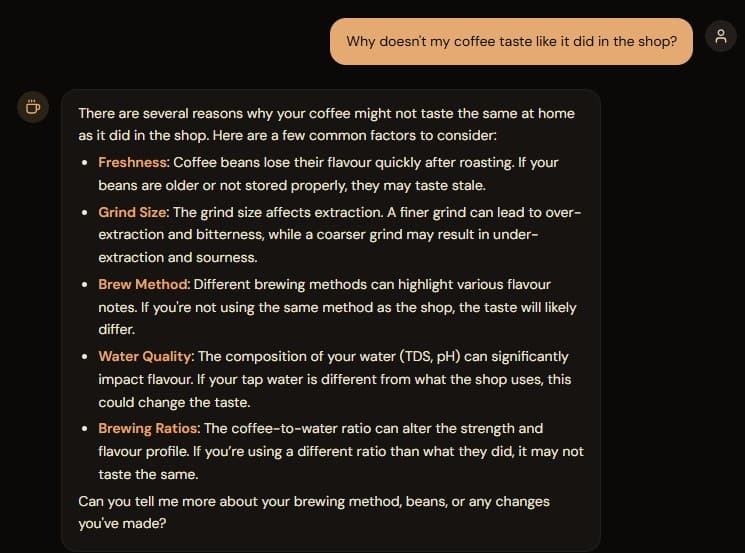
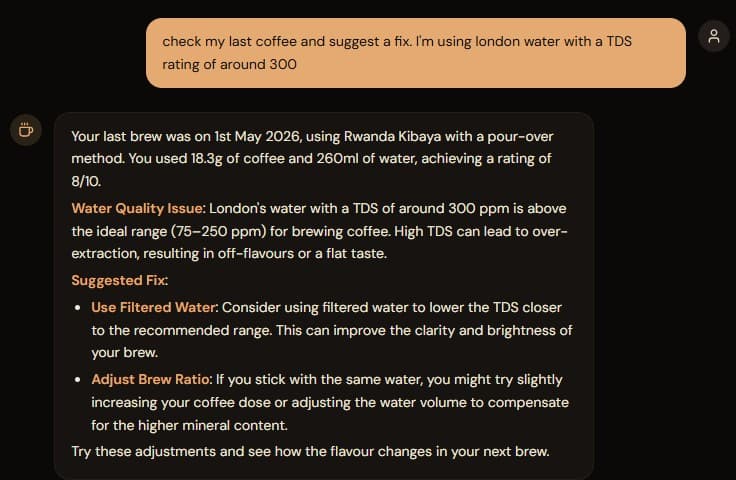
Description
Coffee Rambler AI helps explain why shop brews can taste better by comparing workflow, grinder behaviour, water, and extraction variables. It then suggests one high-impact next test so improvements are measurable rather than guesswork.
Try this in Coffee Rambler AI
Ask the chat: "I bought the same beans as my coffee shop, but my home brew tastes flatter and less sweet. What should I test first?" Then run one change at a time and log each result.
FAQ
- Why does cafe coffee taste better than my home brew?
- Coffee shops often have tighter grinder calibration, more stable water, and highly repeatable workflow timing. Small consistency gains across these variables can make cups taste sweeter and clearer.
- Can I match coffee shop quality with home equipment?
- Yes, in many cases you can get very close by improving consistency first. Focus on grind quality, water, and controlled recipe execution before changing many variables at once.
- What should I test first when my home brew tastes flat?
- Start with one controlled change that is likely to improve extraction quality, such as grind setting or brew contact time, then log the result before making another adjustment.
- How can Coffee Rambler AI help me close the quality gap?
- Coffee Rambler AI can compare your brew context to likely shop-level differences and suggest one focused next test, so you can improve cup quality step by step.